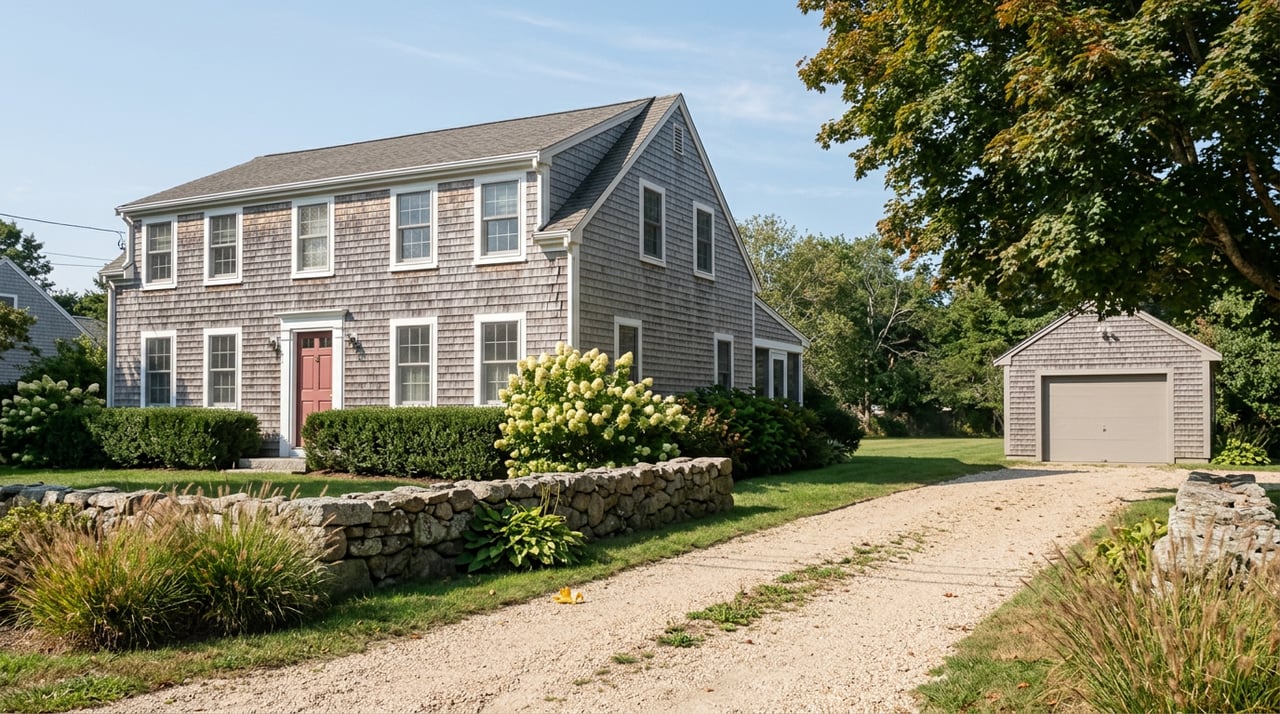
If you're cross-shopping North Yarmouth against its coastal-adjacent neighbor Yarmouth, the assumption is usually simple: North Yarmouth is inland, no Royal River frontage, no historic Main Street, no walkable village center to speak of, so it should cost meaningfully less. As of August 2026, that gap is a lot smaller than the map suggests. North Yarmouth's median list price sat at $749,000, according to listing data pulled that month, essentially within shouting distance of what Yarmouth homes have been selling for. The reason isn't hidden charm. It's a law voters passed in 2022 that caps how many new homes can be built in North Yarmouth each year, no matter how many buyers show up.
That distinction matters if you're deciding between these two towns based on price alone. Here's what the numbers actually show, and why the mechanism behind them is more useful to understand than the numbers themselves.
The Gap Is Smaller Than It Should Be
Yarmouth's numbers bounce around depending on the month and the source, which is itself a clue about how thin these markets are. Sale data from December 2025 put Yarmouth's median at $786,000, up sharply from the year before, but on a sample of just seven homes sold that month. A separate market snapshot for January 2026 put the median list price at $847,000 across 18 homes. A longer-run home value estimate landed at $753,240. None of these numbers contradict each other so much as they reveal a town where a handful of closings can swing the median by tens of thousands of dollars in either direction.
North Yarmouth's $749,000 median list price in August 2026 sits inside that same range. Two years earlier, in 2024, the average detached house in North Yarmouth was valued closer to $644,000. That's roughly a 16 percent run-up in a market that, on paper, has none of Yarmouth's amenities working in its favor. If distance to water and a walkable downtown were driving the price difference between these towns, North Yarmouth should be trading at a real discount. It isn't, and the reason has nothing to do with dock access.
The Real Lever Is a Vote, Not the Land
In March 2022, North Yarmouth residents passed a citizen-initiated referendum by a vote of 731 to 533 that put a hard ceiling on residential growth. The details are specific enough to matter for anyone trying to time a purchase here.
| Zoning District | Annual Permit Cap | Per-Applicant Limit |
|---|---|---|
| Village Center + Village Residential (combined) | 15 units/year | 6 units/year |
| Farm & Forest District | 15 units/year | not separately capped |
| Townwide total | 30 units/year | — |
Before this vote, the Village Center and Village Residential districts had no cap at all. Now, between those two districts and the much larger Farm & Forest District, the entire town is limited to 30 new residential building permits a year, full stop. It doesn't matter how many builders want to break ground or how many buyers are waiting. The town issues 30 and stops, according to the Portland Press Herald's coverage of the vote.
That's the part a median price comparison can't show you. A typical market lets supply chase demand: prices rise, builders respond, more permits get pulled, and the increase moderates over a year or two. North Yarmouth removed that release valve on purpose. Demand can keep climbing and supply legally cannot follow past 30 units townwide in a calendar year.
Why the Ceiling Pushes Prices Up Instead of Just Slowing Things Down
A permit cap alone would be a story about scarcity. What compounds it in North Yarmouth is that new construction here is also expensive to build by default. The town has no public sewer system in most areas, which means new subdivisions run on private wells and on-site septic. A subdivision application filed for a four-lot project on Gray Road laid this out plainly: each lot served by its own private drilled well and its own septic system, no shared infrastructure, no municipal connection.
Wells and septic systems need room. That pushes lot sizes up, which pushes the cost of a buildable lot up before a single stud goes into the ground. Look at what's actually listed for sale in North Yarmouth right now and the pattern shows up immediately: homes here tend to sit on noticeably larger footprints than the county norm, which tracks with a town where every new build has to accommodate its own water and waste system rather than tapping into shared lines.
There was a 2022 proposal to let the Village Center district drop its minimum lot size to 20,000 square feet, but only for lots served by an advanced wastewater treatment system, itself an added cost most builders would have to pass along. Even the town's own attempt to create room for smaller, more affordable lots came with a price tag attached.
Put the two mechanisms together and you get a town where supply is capped by ordinance and each unit of that limited supply costs more to build than it would somewhere with public sewer. That's a very different story than "no water view, so it should be cheaper."
The 2026 Pipeline Won't Change the Math This Year
If you've heard that North Yarmouth has development in the works, you're not wrong. The town's Planning Board has had real projects moving through review in 2026, including the Maple Ridge Preliminary Subdivision, an amended subdivision at 80 Haskell Road, and a minor subdivision at 1473 North Road, all listed on the board's early-2026 agenda.
Here's the part worth sitting with: none of that activity can add more than 30 units to the town's housing stock this year, because the cap doesn't bend for a busy pipeline. A subdivision moving through preliminary review in March could still be waiting on final permits well into next year simply because the calendar year's allotment filled up elsewhere in town first. If you're watching agenda items and assuming they translate directly into near-term inventory, you're measuring the wrong thing.
What This Means If You're Choosing Between These Two Towns
A few practical takeaways if North Yarmouth and Yarmouth are both on your list:
- Don't shop list price and assume the discount is real. Given how few homes sell in either town in a given month, one or two closings can shift the median by tens of thousands of dollars. Look at a rolling few months of activity, not a single snapshot.
- New construction has a different clock here than resale does. If a builder tells you a lot is "in the pipeline," ask where that project sits relative to the 30-unit annual cap, not just where it sits in the approval process.
- Existing homes aren't subject to the growth cap. The permit limit governs new residential construction, not the resale of homes already standing. If timing matters more to you than being the first owner of a new build, the existing housing stock moves on a normal calendar.
- Well and septic costs are part of the real budget, not a footnote. Ask early what a given lot's water and wastewater setup actually requires before comparing it to a home on public utilities elsewhere in the county.
A Couple of Questions Worth Asking Directly
Does the 30-unit cap apply to renovations or additions to existing homes? No. The ordinance governs permits for new residential dwelling units, the kind that come out of new subdivisions and lot splits. Renovating or expanding a home you already own isn't part of that count.
If the sales data bounces around this much, can I trust any single number I see for these towns? Treat any one month's median as a data point, not a conclusion. Both towns sell in the range of single digits to a couple dozen homes in a typical month. That's exactly why looking at trend lines across several months, and understanding what's actually pushing them, matters more than the headline figure.
If you're weighing North Yarmouth against Yarmouth, Falmouth, or anywhere else in this part of Cumberland County and want someone to run the real numbers with you instead of the ones on a portal homepage, Shivam Kumar works these towns directly and can walk you through what a given lot, permit timeline, or septic requirement actually means for your budget. Let's Connect.